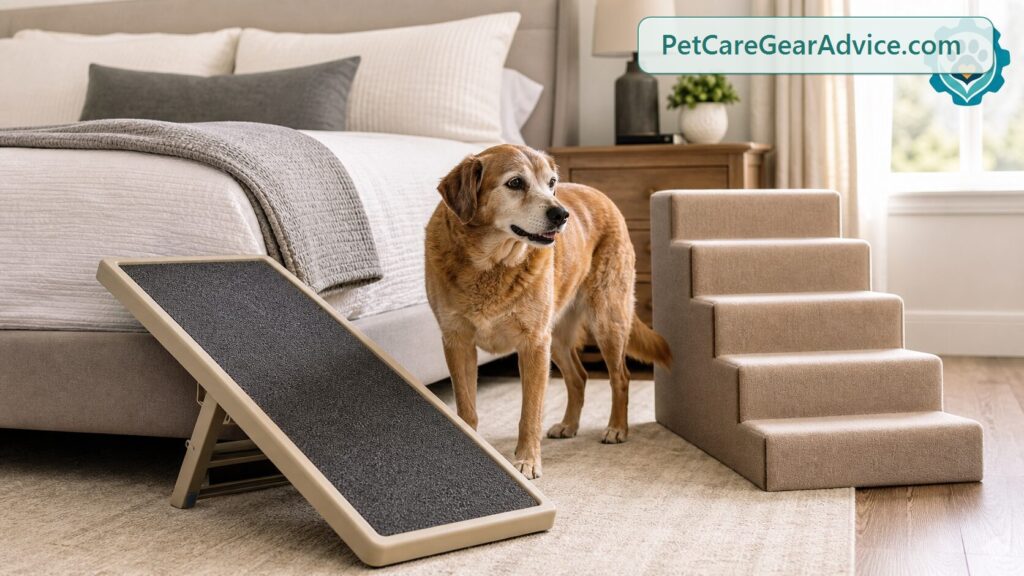
If your older dog is starting to struggle with the bed, couch, car, or stairs around the house, you may be wondering whether a dog ramp or dog stairs would be the better choice.
Both options can make access easier, but they do not work the same way. A ramp gives your dog a sloped walking surface, while stairs require your dog to step up and down. For a young, confident dog, either may be fine. For an older dog, the better choice depends on size, strength, balance, bed height, available space, and how comfortable your dog is with each type of movement.
This guide compares dog ramps and dog stairs from a practical senior-dog perspective, so you can choose the option that better fits your dog’s daily routine.
Safety note: This article is for general informational purposes only and is not veterinary advice. If your dog is limping, falling, crying out, suddenly refusing to climb, or showing signs of pain, consider speaking with your veterinarian.
Short Answer
For many older dogs, a dog ramp may be the better choice because it can reduce the need for jumping and may make access easier with a gentler incline. Ramps are often especially useful for large dogs, dogs that hesitate on steps, dogs with short legs, or dogs that need help reaching high beds or cars.
Dog stairs may still work well for some small older dogs that are steady, confident, and comfortable stepping up and down. They can also be easier to fit in small rooms because they usually take up less floor space than a ramp.
The safest option is the one your dog can use calmly and consistently without rushing, slipping, or avoiding it. If your dog is suddenly limping, falling, crying out, or refusing to climb, consider speaking with your veterinarian before relying on new gear alone.
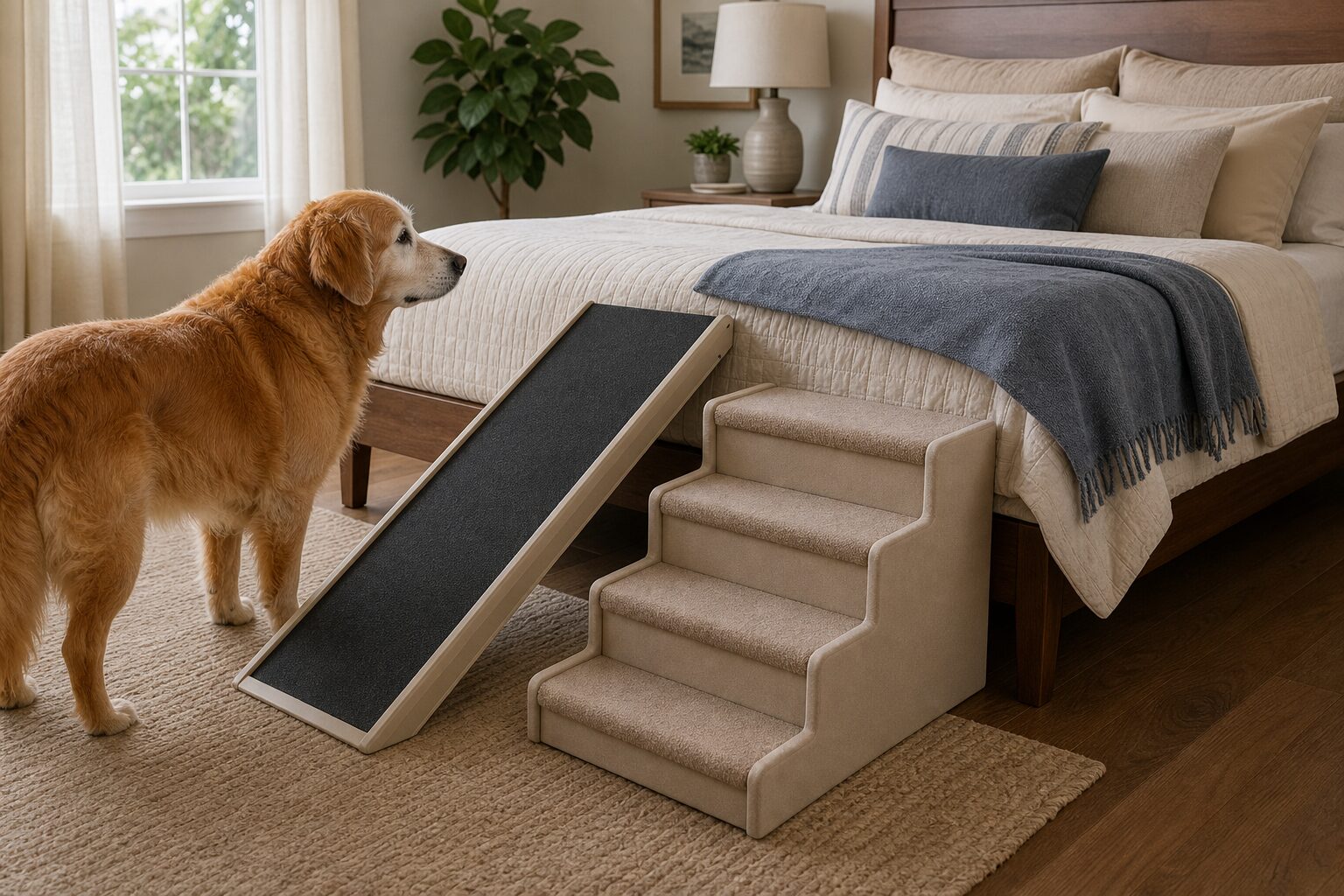
Key Differences Between Dog Ramps and Dog Stairs
The main difference is movement. A ramp asks your dog to walk up a slope. Stairs ask your dog to lift their legs and step from one level to another.
That difference matters more as dogs get older. Some senior dogs find stepping up harder than walking on a gentle slope. Others dislike ramps because the angled surface feels unfamiliar. Your dog’s confidence matters just as much as the gear itself.
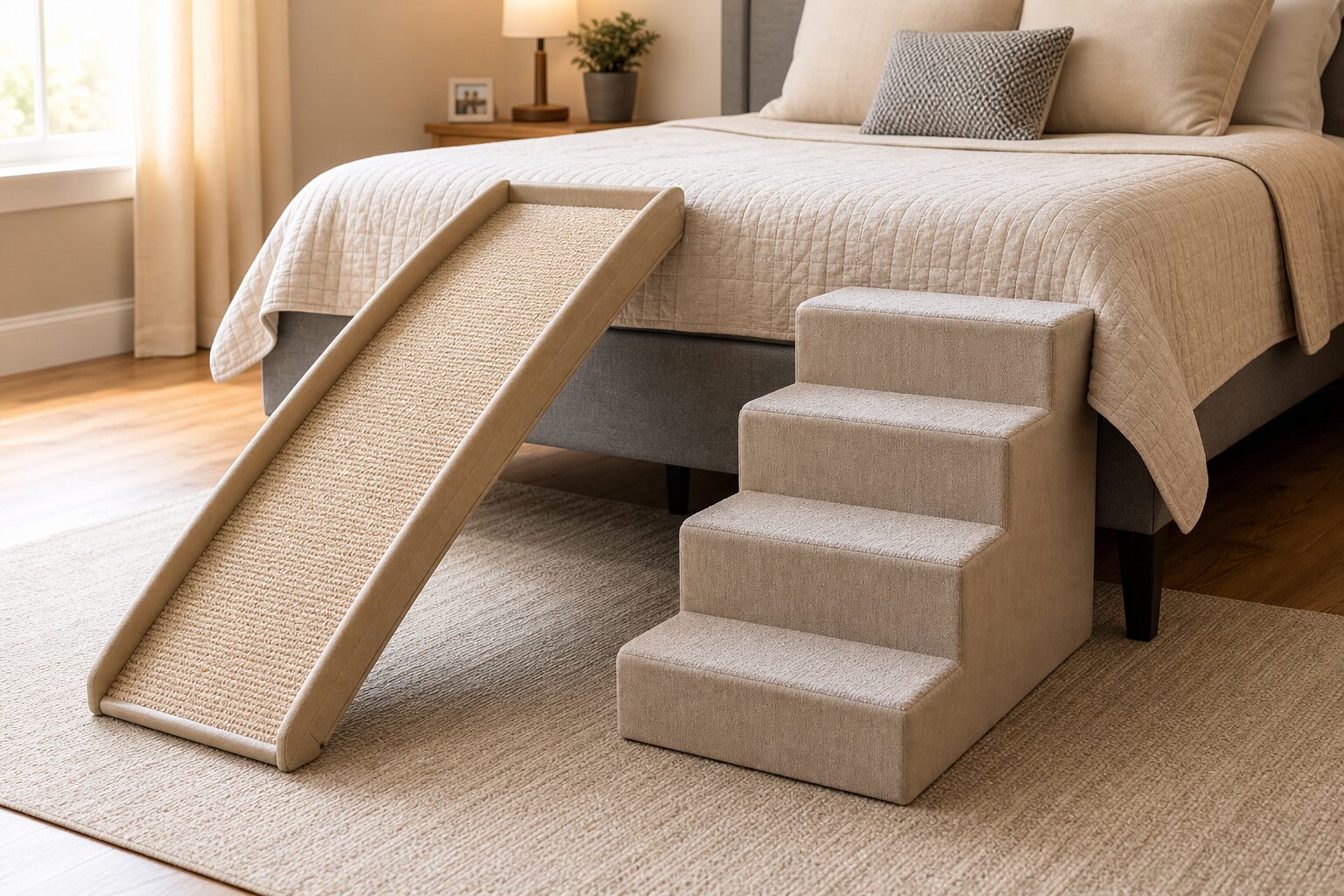
| Factor | Dog Ramp | Dog Stairs |
|---|---|---|
| Movement | Walking up an incline | Stepping up and down |
| Best for | Gentler access, high beds, cars, large dogs | Small dogs, low furniture, tight spaces |
| Space needed | Usually more floor space | Usually less floor space |
| Training | May need slow introduction | Often familiar if dog already uses steps |
| Main concern | Too steep or slippery | Steps too tall or narrow |
When a Dog Ramp Is Better
A dog ramp is often the better option when your older dog needs a smoother path onto furniture or into a vehicle. The biggest advantage is that your dog does not need to make repeated step-up movements.
A ramp may be a better fit if your dog:
- Hesitates before jumping onto the bed or couch
- Has trouble lifting their legs high enough for steps
- Is large, heavy, or hard for you to lift safely
- Needs access to a high bed, SUV, or vehicle
- Slips or rushes when using stairs
- Seems more comfortable walking than climbing
Ramp design matters. A ramp that is too short can become too steep. A surface that is too smooth may make your dog nervous. For senior dogs, look for a ramp type with a stable base, enough width, a surface with good grip, and a length that creates a manageable incline.
When Dog Stairs Are Better
Dog stairs can be useful when your dog is small, steady, and already comfortable with step-like movement. They often work well beside couches or beds where floor space is limited.
Stairs may be a better fit if your dog:
- Is small or lightweight
- Already uses household steps confidently
- Needs help reaching a low or medium-height bed
- Does not like walking on a sloped ramp
- Needs a compact option for a small room
The step height is very important. Tall, narrow, or slippery steps can be difficult for older dogs, especially short-legged dogs. Low, wide steps with a non-slip surface are usually more practical than steep steps that look compact but feel awkward to use.
Which Is Safer for Senior Dogs?
There is no single answer for every senior dog. A ramp may be easier for many older dogs because it can reduce jumping and may make access more gradual. However, a ramp that is too steep or slippery is not a good setup.
Stairs can be suitable for some older dogs, especially small dogs that still climb calmly. But stairs may be harder for dogs with poor balance, weak back legs, or hesitation when stepping down.
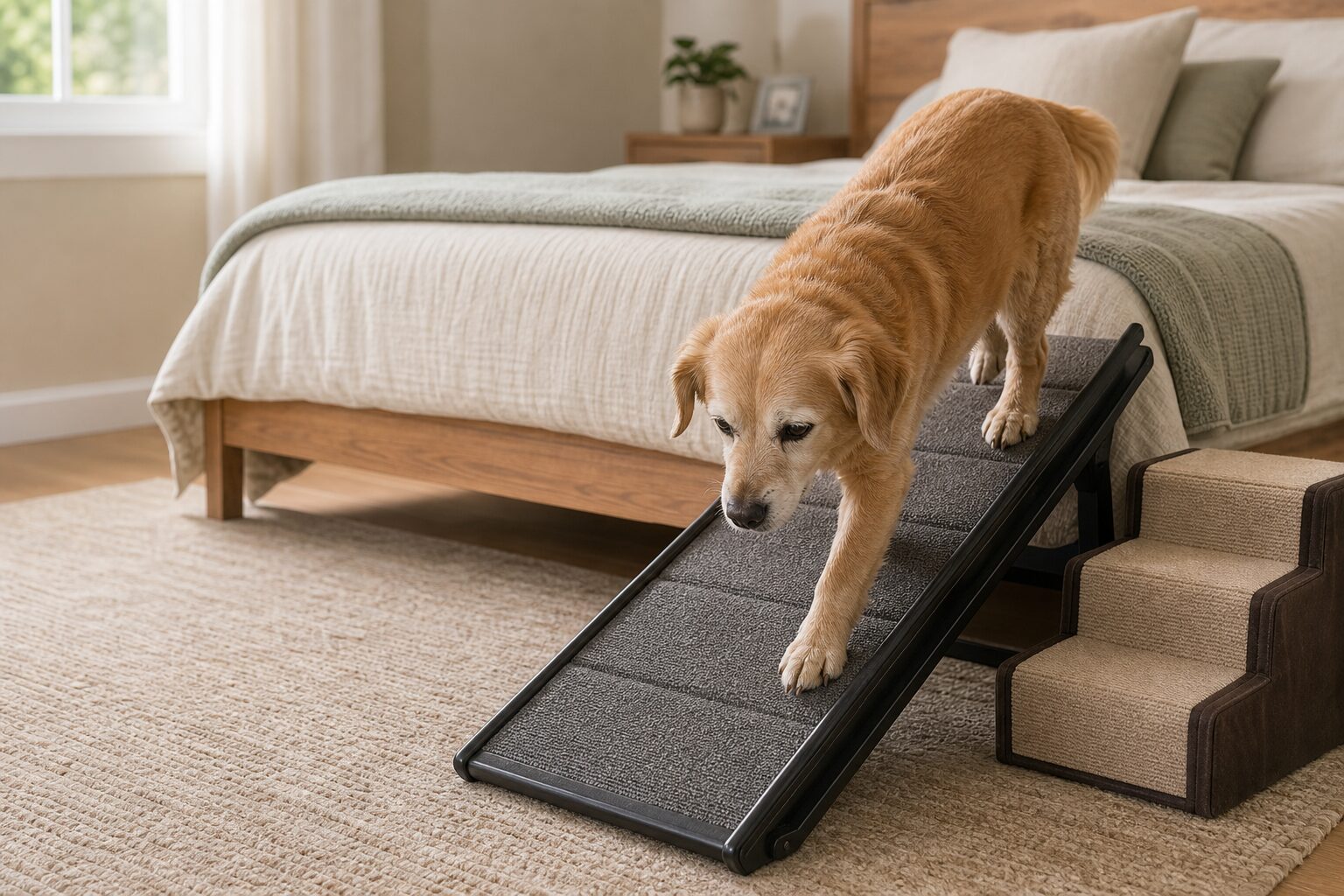
The safer choice is usually the one that meets these conditions:
- Your dog uses it without rushing
- The surface has good traction
- The gear stays stable during use
- The height or incline matches your dog’s ability
- Your dog can go both up and down comfortably
It is also helpful to place a non-slip rug at the bottom of the ramp or stairs. Older dogs often need steady footing before they even start climbing.
Which Is Better for Small Older Dogs?
For small older dogs, both ramps and stairs can work, but the details matter. Small dogs may do well with low dog stairs if each step is short, wide, and easy to climb. This can be especially helpful for couches or beds that are not extremely high.
However, small dogs with short legs may find tall steps awkward. In that case, a low-incline ramp may make access easier. A ramp can also be useful if your dog has started refusing stairs or seems nervous about stepping down.
For small senior dogs, compare:
- Step height versus your dog’s leg length
- Ramp incline versus available floor space
- Surface grip
- How confidently your dog moves up and down
- Whether the dog needs access to a bed, couch, or car
If your small dog still enjoys using steps and moves steadily, stairs may be practical. If your dog hesitates, slips, or avoids climbing, a ramp may be the calmer choice.
Which Is Better for Large Older Dogs?
For large older dogs, a ramp is often more practical than stairs. Large dogs place more weight on each step, and many dog stairs are not wide or stable enough for confident use by bigger senior dogs.
A ramp can provide a broader walking path, but it still needs to be chosen carefully. A narrow or steep ramp may not feel comfortable for a large dog. For bigger dogs, width, stability, surface grip, and verified weight capacity are especially important.
Large dogs may also be difficult for owners to lift. A ramp can be helpful for beds, cars, and SUVs when lifting is not realistic or comfortable for either the dog or the owner.
Which Is Better for High Beds?
High beds are one of the most common reasons people compare ramps and stairs. The higher the bed, the more important incline or step height becomes.
A ramp can work well for a high bed if it is long enough to create a gentle slope. If the ramp is too short, it may become too steep and your dog may avoid it.
Dog stairs can work for a high bed only if the steps are low enough and the structure is stable. Some stairs designed for high beds may still feel too steep for an older dog, especially when coming down.
For high beds, a ramp is often worth considering first. If there is not enough floor space, low, wide stairs may be the next option, but you should watch how your dog uses them before assuming they are a good fit.
Which Is Better for Cars and SUVs?
For cars and SUVs, ramps are usually more suitable than stairs. Vehicle access often involves a higher entry point and less predictable footing. A portable ramp can create a clearer path into the back seat, cargo area, or vehicle entrance.
Dog stairs for vehicles exist as a general gear type, but they may be harder for some older dogs because the dog has to climb several steps while also dealing with the height of the vehicle.
For vehicle use, consider:
- Ramp length and incline
- Foldability
- Surface grip
- Weight and storage
- Whether the ramp stays stable against the vehicle
If your dog is nervous around the car, introduce the ramp slowly while the vehicle is parked and the environment is calm.
What to Avoid
Whether you choose a ramp or stairs, avoid setups that make your dog rush, slip, or jump from the top.
- Avoid ramps that are too steep for your dog’s comfort.
- Avoid stairs with tall, narrow, or slippery steps.
- Avoid unstable gear that shifts during use.
- Avoid placing ramps or stairs on slippery flooring without a rug or mat.
- Avoid forcing your dog to use new gear before they understand it.
- Avoid assuming refusal is stubbornness, especially if the behavior is new.
Give your dog time to learn. Short, calm practice sessions usually work better than pressure.
Recommended Gear Types by Use Case
At this stage, it is better to think in terms of gear type rather than specific products. The right product can be chosen later after checking dimensions, surface material, weight capacity, and real buyer patterns.
| Use Case | Better Starting Point | Why |
|---|---|---|
| High bed | Long, stable ramp | May create a gentler path than tall steps |
| Small older dog | Low stairs or gentle ramp | Depends on step height and confidence |
| Large older dog | Wide ramp | Usually more practical than narrow stairs |
| Couch access | Low stairs or short ramp | Furniture height is usually lower |
| Car or SUV | Portable ramp | Better suited to vehicle entry height |
| Slippery bedroom floor | Non-slip rug plus access gear | Footing matters before and after climbing |
FAQ
Are ramps better than stairs for older dogs?
Ramps are often better for older dogs that struggle with steps, high furniture, or jumping. However, the ramp must have a manageable incline and a surface with good grip.
Are dog stairs okay for senior dogs?
Dog stairs may be okay for some senior dogs, especially small dogs that still climb calmly. They may not be ideal for dogs with poor balance, weak back legs, or hesitation on steps.
What if my dog refuses to use a ramp?
Some dogs need time to trust a ramp. Start with short practice sessions, use calm encouragement, and avoid pressure. If your dog still refuses, the incline, surface, or placement may not feel comfortable.
What if my dog refuses to use stairs?
Check whether the steps are too tall, narrow, or slippery. If your dog seems uncomfortable or the change is sudden, consider speaking with your veterinarian.
Should I use both a ramp and stairs?
Some homes may use both. For example, stairs near a low couch and a ramp for the bed or car. The best setup depends on where your dog needs help most.
Final Recommendation
If your older dog is large, hesitant, dealing with a high bed, or needs help getting into a car or SUV, start by looking at dog ramps. A stable ramp with a gentle incline and good traction may make access easier for many senior dogs.
If your older dog is small, steady, and already comfortable climbing, dog stairs may be a practical choice for beds or couches, especially when space is limited.
Most importantly, watch your dog’s behavior. The right choice should feel calm, stable, and easy for your dog to use. If your dog is suddenly avoiding movement, limping, falling, or acting uncomfortable, speak with your veterinarian before making gear the only answer.